


Orendy
Orendy vs Quizlet
Quizlet is the world's most well-known flashcard platform, but is it really the best tool for your needs? Here is an honest, detailed comparison to help you decide.
One million sets available also means one million sets to sort through.
Quizlet bets on abundance: content created by other users, in industrial quantities. Convenient to get started, but quality is uneven and nothing guarantees a set will match your level, your curriculum, or your way of learning. Orendy takes the opposite bet: creating your own cards is already the first step of memorization. Rephrasing, choosing examples, organizing content: all of this engages memory before the first review session even begins.
Data & Privacy
Quizlet asks you to identify yourself before you even start learning. Orendy does not know who you are, and that is intentional.
| Feature | Orendy | Quizlet | Why |
|---|---|---|---|
| Account required | NO | YES | Orendy works right after installation, with no email or password. Quizlet blocks access without registration. |
| Works 100% offline | YES | NO | All Orendy features are available without a connection. Quizlet requires internet for most operations and only caches the last 8 sets. |
| Content private by default | YES | NO | On Orendy, your cards stay on your device. On Quizlet, your sets are public by default unless you pay for a subscription. |
| CSV Import / Export on iPhone | YES | NO | In the paid version ($5/year to unlock 100% of features), Orendy lets you import and export decks as CSV directly from the app. You can even prepare your cards in your favorite spreadsheet and import them in one tap. On Quizlet, CSV import is only available from a web browser. That said, the recommendation is to create your cards yourself: the effort of formulation is part of the learning process. |
Actually Learning
Both apps offer spaced repetition. But not with the same level of commitment.
| Feature | Orendy | Quizlet | Why |
|---|---|---|---|
| Spaced repetition (SRS algorithm) | YES | PARTIAL | Orendy applies a full spaced repetition algorithm: each card is scheduled according to its actual difficulty. Quizlet offers a "Learn" mode with study variants, but without rigorous algorithmic scheduling. |
| Mastery level per card | YES | NO | In Orendy, each card displays its review level in real time. You know exactly where you stand, card by card. Quizlet shows overall progress per set, with no individual detail. |
| Wildcards in answers | YES | NO | Orendy accepts multiple variants of the same answer (useful for German articles: der/die/das). Quizlet requires an exact match and counts any variation as wrong. |
| Vacation mode | YES | NO | Orendy lets you pause reviews without losing your progress. Perfect for a guilt-free break. Quizlet does not offer this option. |
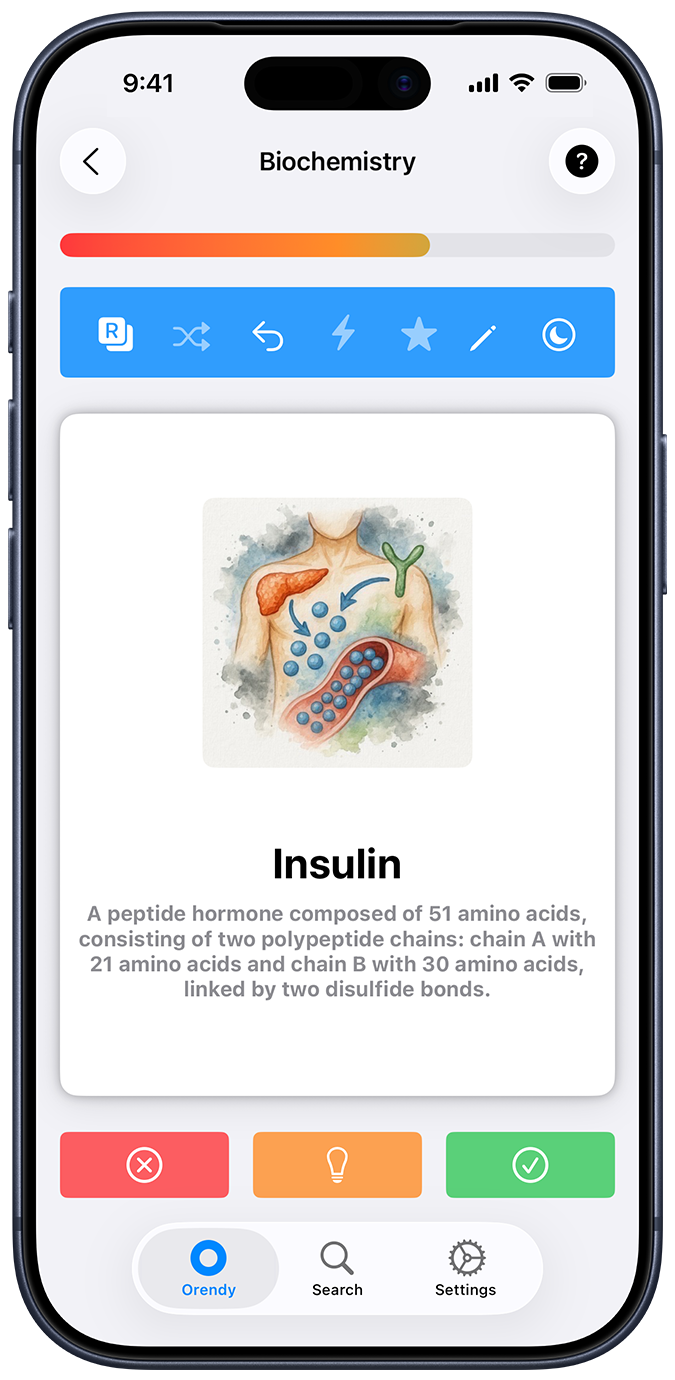
| Rich cards | YES | NO | An Orendy card can contain a term, a definition, variants, examples, synonyms, an image and tags. Quizlet is limited to one term and one definition. |
| Study modes and effectiveness | SRS | AI | Quizlet offers AI-powered exercises. Orendy relies on a proven spaced repetition algorithm (SRS), with card-by-card tracking and smart answer correction. AI makes a good marketing argument; spaced repetition has been backed by cognitive science for decades. And for those who still want to use their favorite AI: nothing stops you from preparing cards with ChatGPT, exporting them as CSV, and importing them into Orendy in seconds. |
Organization That Scales
Managing 50 cards or 5,000 is not the same challenge. Orendy was built for both.
| Feature | Orendy | Quizlet | Why |
|---|---|---|---|
| Folders / Decks / Cards hierarchy | YES | PARTIAL | Orendy offers a clear three-level organization. Quizlet has folders and sets, but no sub-folders or deep hierarchy. |
| Notebook per deck | YES | NO | Each Orendy deck has a built-in notebook for grammar rules, memos, and context notes. Quizlet has no equivalent. |
| Card tags | YES | NO | Orendy lets you tag each card to create cross-cutting views (e.g. all B2-level cards, all irregular verbs). Quizlet has no tag system. |
Day-to-Day on iOS
Quizlet is a web platform ported to mobile. Orendy is a native iOS app, built for the phone.
| Feature | Orendy | Quizlet | Why |
|---|---|---|---|
| Search inside your own content | YES | NO | Orendy includes a full-text search engine that scans your titles, definitions and tags. Quizlet lets you search public downloadable content, but not find a specific card within your own sets. |
| Edit a card during review | YES | NO | On Orendy, you can correct or enrich a card mid-session without interrupting it. On Quizlet, any edit requires leaving the review mode. |
Verdict
Quizlet is a community platform: it excels if you want access to millions of existing sets and study in a browser. But it requires an account, stores your data in the cloud, and its offline mode is barely functional. Orendy takes the opposite approach: no account, everything local, a real spaced repetition algorithm, and a search that works inside your own content. If you create your own cards and want a tool that truly works for you, the choice is clear.
Ready to try a smarter alternative?
Download Orendy for free on iPhone and iPad. No account, no ads, works offline from the very first launch.